Our offices across 12 countries and 3 continents all share the same vision. Your achievement is the reason for our existence and your growth is our passion.
China’s Electrical Vehicle Sales Expected to Rise 40 Percent Next Year
Share
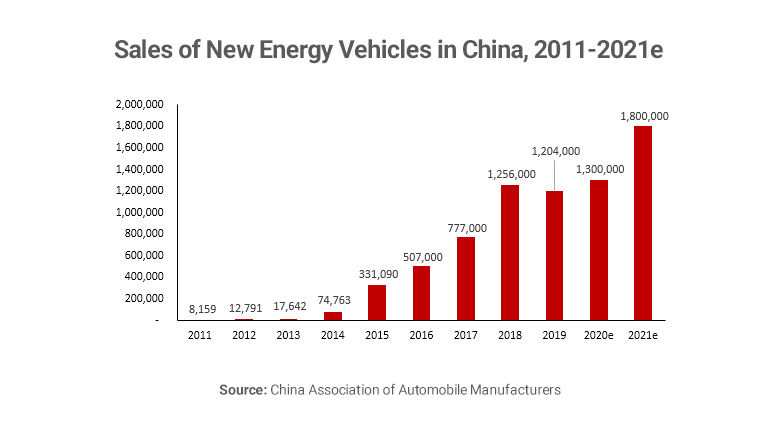
China’s electrical vehicle industry is expected to see rapid growth next year. China Association of Automobile Manufacturers (CAAM) predicts sales topping 1.8 million units next year, compared to an estimated 1.29 million units for the whole of 2020, marking a growth of 40%.
China’s interest for green cars is mounting. With government backed incentives, the industry is expected to keep growing aggressively. NEV (New energy vehicles) buyers in China are eligible to enjoy a 10 percent consumption tax cut. Beijing further offers a cash subsidy of about 22,500 CNY (~3,500 USD) for the purchase of an electric car, as long as the driving range is more than 400 km on a single charge. In Shanghai, the local government gives buyers of NEV’s free license car plates, which otherwise needs to be bought at a cost of around 90,000 CNY (~14,000 USD).
As a part of China’s new 5-year plan (which will be released in its full extent in March 2021), the Government called for a continuous green transformation of production and people’s lifestyles. The clear ambition brings tons of opportunities for companies within the Energy & Environment sector, producers of electrical vehicles being one clear winner. By 2025, deliveries of green cars are expected to account for a fifth of the market, up from less than 5 percent in 2019.
Many new players are joining the race to grab a share of China’s gigantic car market. The three Chinese NEV brands NIO, Xpeng and Li Auto, listed on the New York Stock Exchange, has seen a rapid interest increase lately. Now, the list of the world’s most valuable automakers has been reshuffled. NIO has a market cap (as of December 2020) of 66 billion USD, while Xpeng and Li Auto are valuated to 34 billion USD and 28 billion USD respectively. Putting this into perspective, we find Ford’s market cap being 36 billion USD and Nissan 22 billion USD. Adding to that, Tesla targets the Chinese market more and more, with the initial production of their newest model, Model Y, already in production at Tesla’s enormous Gigafactory in Shanghai.
To further build the hype around China’s NEV market, it is reported that Baidu is considering making its own NEV’s, and have held discussions with several carmakers about the possibilities of collaborating on this co-development. Baidu, which is commonly referred to as “China’s Google”, are the latest tech-firm to join the race for developing smart cars. Building cars would mark a checkpoint of dramatic development in Baidu’s push to diversify income streams.
However, Chinese carmakers need to overcome a shortage of semiconductors (caused by the COVID pandemic) before being able to rev up the production next year. Lockdowns in Europe has disrupted the production of semiconductors, which is a key component for all carmakers and car parts suppliers, including the Chinese ones. Some assemblers might be forced to reduce, or even halt output completely, unless the bottleneck of semiconductors is being solved.
In conclusion, the sales of Chinese electrical vehicles are expected to rise dramatically next year. Driven by a desire to transform China to a more climate neutral and green nation, the government offers highly lucrative incentives for its citizens. Many companies are now trying to grab a share of China’s huge car market, but they all face a shortage of semiconductors which has to be solved before ramping up the production.
Introduction: The Assumption that No Longer Holds Jurisdiction is alpha. Not in theory, but in practice: across Asia, the corporates best positioned for the next cycle of capital raising are those that treated their cross-border structure as a strategic asset, not an administrative necessity. The assumption was simple: capital would naturally move toward the deepest […]
Executive Summary State Council Decree No. 837 (effective July 1, 2026) establishes a security-focused legal framework that reshapes outbound M&A. It does not ban consumer sector deals, but it changes how they must be structured, approved, and integrated. Expansion of Regulatory Scope: Individual Investors and Indirect Structures Brought into the Compliance Scope Resident individuals are, […]
Overview Corporate AI has settled into a familiar pattern: broad use, thin value. Close to 90% of companies now use AI routinely in at least one business function, yet only a handful have turned that into value at enterprise scale. The bottleneck is not the technology. It is the organization. At its core, AI transformation […]
Subscribe to New Articles and ARC Group Updates
Receive our latest market insights, news and reports, and business bulletins.
Manage Consent
To provide the best experiences, we use technologies like cookies to store and/or access device information. Consenting to these technologies will allow us to process data such as browsing behavior or unique IDs on this site. Not consenting or withdrawing consent, may adversely affect certain features and functions.
Functional
Always active
The technical storage or access is strictly necessary for the legitimate purpose of enabling the use of a specific service explicitly requested by the subscriber or user, or for the sole purpose of carrying out the transmission of a communication over an electronic communications network.
Preferences
The technical storage or access is necessary for the legitimate purpose of storing preferences that are not requested by the subscriber or user.
Statistics
The technical storage or access that is used exclusively for statistical purposes.The technical storage or access that is used exclusively for anonymous statistical purposes. Without a subpoena, voluntary compliance on the part of your Internet Service Provider, or additional records from a third party, information stored or retrieved for this purpose alone cannot usually be used to identify you.
Marketing
The technical storage or access is required to create user profiles to send advertising, or to track the user on a website or across several websites for similar marketing purposes.