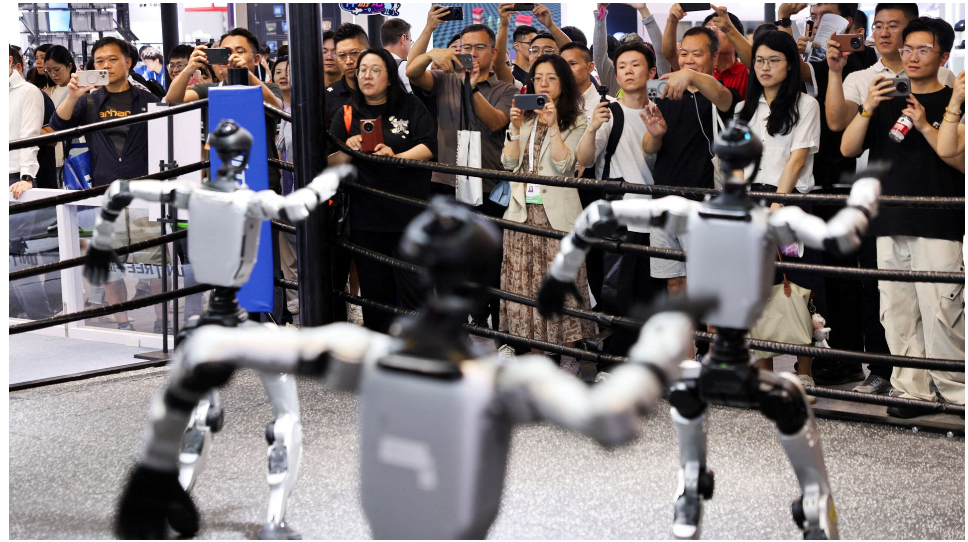
Unitree Roboticsʼ triumphant STAR Market debut on Wednesday saw the Chinese robotics giant earn the title of “the first humanoid robotics listing” in mainland China, along with a jaw-dropping 629.4% share price surge to hit a market cap of about $66 billion.
Millions of retail investors scrambled to subscribe to its initial public offering (IPO), driving a record-low
online IPO lottery winning rate of 0.018% and making it the single hardest allotment to win in STAR
Marketʼs six-year history.
On the southern coast of China, a flood of listings by artificial intelligence (AI) companies also contributed to another stellar half-year IPO performance in Hong Kong, with 87 new listings collectively raising HK$212.4 billion ($27.1 billion) in the first six months of 2026.
The cityʼs half-year IPO fundraised represents a 94% jump year-over-year (YoY), according to 2026 interim results released on the same day by the exchange operator, Hong Kong Exchanges and Clearing Limited (HKEX). The operator attributed this IPO boom in part to “strong interest in Chinese mainland technology and AI-related stocks.”
Top IPO candidates currently face no shortage of investor demand across both private and public markets. This is particularly true for IPO-bound, first-rate Chinese AI labs, which have continued to receive “love letters” from global funds vying for an allocation, Sean Xiang, founder and CEO of Hermitage Capital, told DealStreetAsia.
Todayʼs enormous appetite for AI and robotics IPOs in Greater China signals a listing window that has
reopened since 2025 after years of muted new-share issuance. Recovering investor confidence coincided with Hangzhou-based large language models (LLMs) developer DeepSeekʼs release of its open-weight R1 model, which showcased frontier reasoning capabilities at a fraction of Western compute costs. The release of DeepSeekʼs R1 model in January 2025, which triggered a global tech market correction, later became widely known as the “DeepSeek moment.”
Since then, an AI-centric drive has given rise to an expanding list of highly anticipated IPO plans—ranging from DeepSeek and its AI lab peers like Moonshot AI and StepFun to embodied intelligence leaders including Unitree, X Square Robot, Galbot, Galaxea AI, LimX Dynamics, and AI² Robotics. And the pipeline continues to grow.
As more companies flock to capture this IPO boom, candidates from AI and embodied intelligence together account for 22.2% of an estimated 60-plus Chinese high-growth tech IPO hopefuls, according to data compiled and released by iiMedia Research on August 17.
The Chinese market analysis company highlighted a strong focus on deep tech among Chinese pending IPOs nowadays, with AI and embodied intelligence, commercial space launch, and semiconductors forming what it calls “a golden triangle” and collectively representing 46% of all prospective deep tech listings in the country.
After the January Hong Kong listings of multimodal foundation models developers MiniMax Group and Z.ai, recent IPO momentum has shifted towards embodied intelligence—a subset of AI centered on physical systems, like humanoid robots and quadruped robots, so that AI can perceive, reason about, and directly interact with the physical world. And Unitreeʼs blockbuster IPO offers a great opening to this next phase.
Embodied intelligence is “an upcoming story” in the IPO market, said Hermitage Capitalʼs Xiang, who
expects the listing window for AI and embodied intelligence in Greater China to stay open for another six months, while noting that a one-year projection remains difficult.
“One of my tasks is to gauge when the music will stop. But honestly, we donʼt know… However, we are
undeniably in the second half of a bull market. We must be very careful of how to maintain our positions,” said Xiang.
Soaring valuations, policy tailwinds drive China’s AI IPO rush
In private markets, the sustained IPO window, combined with Chinaʼs state policy and revamped listing
rules favouring deep tech, is driving unprecedented fundraising speed and valuation growth.
DeepSeek, arguably the most anticipated STAR Market IPO hopeful, reportedly resumed its second funding round in early August, seeking close to $8 billion at a valuation around $74 billion. This target represents a 48% surge from just two months ago, when it was valued at over $50 billion following its $7.4 billion first external financing.
Building on the momentum of its breakthrough Kimi K3 model launch in mid-July, Moonshot AI rapidly reached a $35 billion valuation aiter securing a larger-than-anticipated $3.5 billion round. The company is now reportedly approaching potential backers for a new round at a $50 billion pre-money valuation, aiming to lock in final capital ahead of a Hong Kong IPO as early as this year.
Similarly, StepFun dismantled its offshore “red-chip” structure after raising over 5 billion yuan ($741.5
million) in January and swiftly closed a pre-IPO financing round in May at more than $2 billion. By June, key investors reportedly proposed valuing the company at up to $12 billion as it prepares for its Hong Kong listing.
Meanwhile, embodied intelligence is witnessing a massive fundraising boom. Startups in the sector
completed at least 217 deals totaling well over $9.8 billion in H1, according to DealStreetAsia data. As the industry transitions from VC-backed experimentation to mass industrial scaling and commercial
deployment, embodied intelligence leaders are also accelerating their march toward public markets.
Regulators have rolled out the red carpet for an ever-expanding slate of AI IPO candidates. Both the HKEX and Shenzhenʼs ChiNext board have relaxed thresholds or introduced new standards to accommodate high growth deep tech IPO issuers that have yet to reach large commercial scales.
Similarly, the Shanghai Stock Exchange updated its STAR Market framework in June to explicitly support frontier fields, including embodied intelligence and robotics. This policy push, paired with fast-tracked reviews for pioneering tech companies, enabled Unitree to secure listing approval in just 73 days—making it the fastest STAR Market IPO to date.
The AI super cycle and massive infrastructure spending are driving global stock markets to book a record IPO year. Hong Kong—which reclaimed the worldʼs top spot in 2025 with HK$285.8 billion ($36.4 billion) of IPO fundraising across 119 new listings, the highest annual total since 2021—is likely set for an even greater year for IPO activity, riding on its robust H1 results.
As of August 19, public disclosures on the HKEX website showed a pipeline of over 340 active IPO applicants, excluding confidential filings. Based on the first-half pace of 87 completed listings, clearing this backlog would take well over three years.
Facing a crowded IPO pipeline, a bifurcation in IPO performance seems inevitable. Compared to last yearʼs scarcity-driven market, “I am starting to see a flight to quality in the second half [of 2026],” said Jireh Li, a partner at INCE Capital.
Hedge funds and investment bankers are prioritising issuers with “resilient trading” prospects—those with strong tech IP, robust product pipelines, solid commercial health, and sound fundamentals, Li noted. She is of the view that this performance split could widen further over the rest of 2026.
Crowded pipeline, practical constraints, and the race to beat the clock
Besides the few most sought-after IPOs, Hong Kongʼs vast IPO pipeline includes legacy tech assets whose private shareholders held through a three-year downcycle and are now attempting to leverage “AI rebranding” to secure exits, said a China-focused AI venture capitalist who spoke on condition of
anonymity.
The person said that supply of non-core AI IPOs has seemingly exceeded demand, creating exit risk for late stage investors behind private rounds priced at 2021-2022 market peaks.
A second person familiar with the matter confirmed the trend, noting that steep discounts on secondary sales also make IPOs a more attractive exit for such high-priced, non-core AI assets.
However, fund managers attempting to list legacy tech assets are meeting growing caution in public
markets. “In pre-IPO rounds, we see more global investors, mostly from the Middle East and Europe,
assessing these deals very seriously to also participate in the IPO. But is that enough to absorb the entire [IPO] pipeline? I donʼt think so,” said the first person.
“That is probably why companies are rushing to be first to list in the [AI or embodied intelligence] category —to capture that limited pool of capital.”
Despite the sprawling IPO pipeline, ARC Groupʼs managing director Gordon Crosbie-Walsh is bullish that public and private investors retain strong demand for Chinese AI issuers, particularly as buyers look beyond core AI labs to diversify across the broader AI value chain.
Institutional investors maintain extensive buy-lists from pre-IPO rounds to secondary trading. “There is still very wide interest,” said Crosbie-Walsh, who advises on cross-border transactions, IPOs, and SPAC listings.
Beyond investor appetite, however, “practical constraints” exist. Investment banks, exchange operators, and regulators face growing bandwidth limits. In January, the Securities and Futures Commission (SFC) issued a circular targeting “serious deficiencies” in sponsor practices, introducing stricter reporting requirements and enhanced oversight. Crucially, the SFC now considers a sponsor principal managing six or more active IPO engagements to be “strained”—presuming a lack of adequate resourcing and establishing an effective ceiling of five concurrent deals.
As a result, investment banks are actively prioritising higher-profile, higher-value issuers, most notably AI companies, while smaller-cap and less-prepared listing candidates face IPO delays that could extend well into the second half of 2027, Crosbie-Walsh estimated.
“For AI, there is a priority. If you talk to investment banks, because of the size [and] because of the timing in the market being very AI-focused, they are prioritising those deals,” said Crosbie-Walsh. “I think their chances are good, and those IPOs will stay on track.”
Edited by: Padma Priya