Heavy AI Spending, Slow Returns: Why Organizational Redesign Comes First
Share
Overview
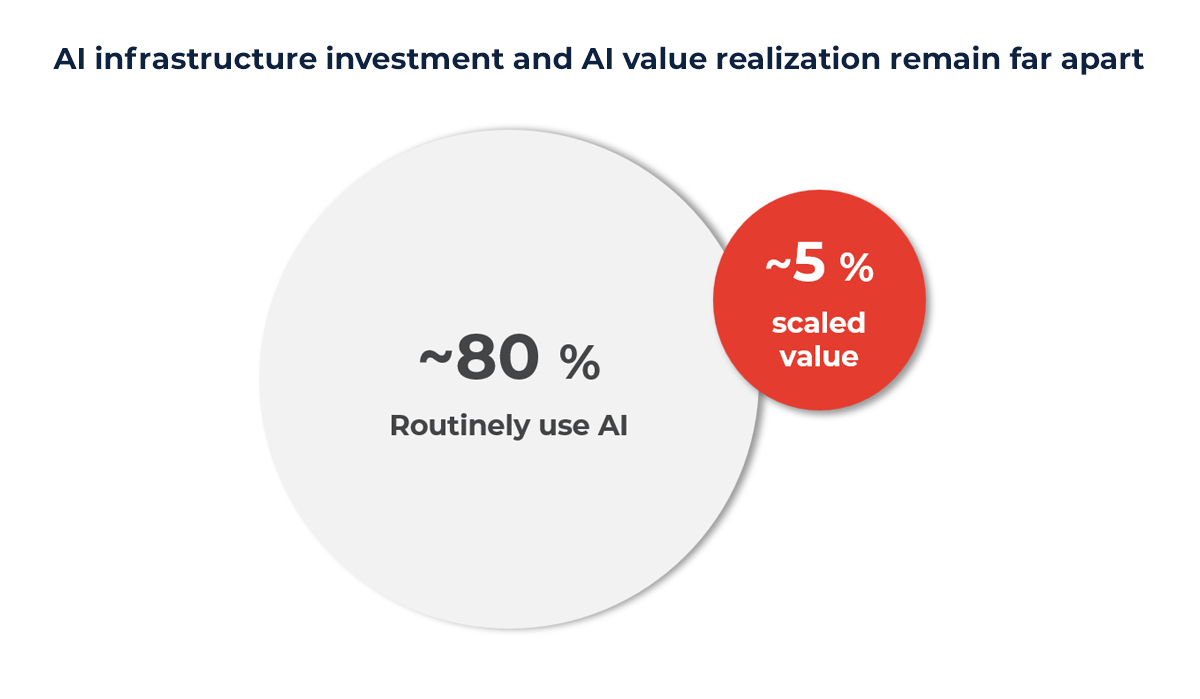
Corporate AI has settled into a familiar pattern: broad use, thin value. Close to 90% of companies now use AI routinely in at least one business function, yet only a handful have turned that into value at enterprise scale. The bottleneck is not the technology. It is the organization. At its core, AI transformation is a reshaping of how an organization creates value, and it asks companies to fix three misalignments at once: mindset, structure, and talent. The companies that get this right move in stages, from a “people lead, tools assist” model toward genuine collaboration between people and machines.
Adoption Is Near-Universal. Value Is Not.
Across the global economy, enterprise AI shows the same divide: widely adopted, rarely valuable. Public surveys from several research firms tell a consistent story. Nearly 90% of companies now use AI as a regular part of at least one business function, while only about 5% have achieved value at enterprise scale.
The ARC view
AI is not the next upgrade in the toolkit. It changes how an organization is built to create value. The hierarchical, bureaucratic company is a product of the industrial age, and its command logic sits uneasily with the real-time coordination and continuous learning that AI makes possible. To unlock what AI can do, the real work is not buying or deploying systems. It is adapting strategy, structure, talent, and governance together, as a single transformation.
The Barrier Is Organizational: Three Misalignments
The mindset trap: treating AI as a tool, not a driver of change
For most companies, the first obstacle to scaling AI is not technology or budget. It is how leadership thinks about it. Many treat AI as a way to make a single task faster, file it under IT as a routine systems upgrade, and never raise it to the level of company strategy. That misreading produces a familiar imbalance: heavy spending on procurement, little attention to redesigning the organization.
What sets AI apart from earlier IT tools is its ability to learn on its own, reshape processes, and create new operating models. Putting it to work means rebuilding how the business runs, how it decides, and how it creates value.
The misjudgment sets off a chain of problems. AI stays stuck in small departmental projects that never add up to company-wide growth. Leaders chase short-term cost cuts and forgo the larger prize of new business models and durable advantage. And the organization clings to its old habits, losing the appetite for change that AI demands.
The structure trap: siloed pilots without company-wide coordination
An organization built around layers and functions works against everything AI is designed for: data that flows freely, coordination across the whole company, and constant iteration. The result is the classic silo trap.
Most companies still lack a single top-level plan for AI. Departments run scattered pilots, buy their own tools, and build their own models, each in isolation. The fragmentation is expensive, and much of the cost is internal friction.
Linear approval chains cannot keep pace with how quickly AI moves. As AI agents grow more capable and cross-functional work becomes the norm, rigid department lines give way to shared points of collaboration. Left in place, the siloed structure becomes the main brake on transformation.
The talent trap: hiring specialists while ignoring how current teams work
Many companies fall into one costly assumption: that AI transformation means hiring technical people and standing up technical systems. They spend heavily on engineers in algorithms, data, and architecture, and overlook the harder task of changing how everyone else works.
In practice, the core of AI transformation is rebuilding how people and machines work together, not stockpiling technical talent. How employees think and work sets the ceiling on what AI can deliver.
Today most companies have neither built AI literacy across the workforce nor redrawn roles, workflows, and performance measures around human-machine collaboration. The old, people-led way of working stays in place, and the predictable result is a split between technology and the business: the specialists understand the algorithms but not the work, while the people who know the work cannot use AI to do it better.
Four Moves That Close the Gap
Reset the mindset: from efficiency tool to engine of growth
The aim is to move the company from passively fitting AI into existing work to actively making it a source of growth. That shift rests on three commitments. Raise AI from an IT project to core strategy: end the idea that AI equals an IT upgrade, have the CEO lead, set up a cross-functional transformation committee, and run CEO-led workshops for the executive team so that leadership’s own doubts are resolved from the top down. Shift the goal from short-term savings to lasting advantage: focus strategy on what AI does over time, remaking the business model, building core capabilities, and growing the value of data as an asset. Move from departmental pilots to company-wide coordination: set shared data standards and clear rules for collaboration, and bring business, technology, legal, and ethics perspectives into one coordinated approach.
Redraw the structure: a five-stage path to an AI-native organization
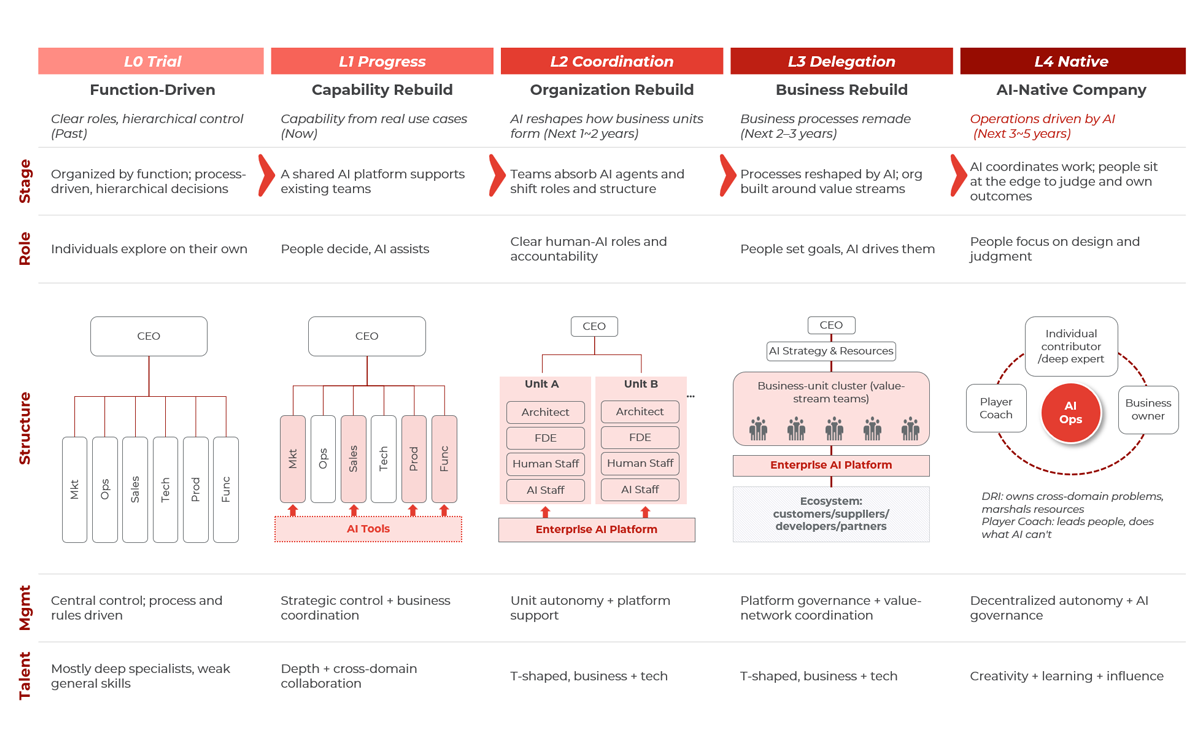
The shift toward an AI-native organization runs through five stages. The thread running through all of them is a transfer of leadership, from traditional functions and individual people toward company-wide AI intelligence held within the systems themselves.
L0, Trial. Function-driven, run entirely by people and departments. This is where most companies sit before any AI redesign begins. The organization is divided along fixed functional lines, with marketing, sales, and technology operating apart from one another, and there is no shared data foundation or enterprise AI capability. Whatever AI tools exist are tied to individual employees and cannot be shared or reused across teams. The company runs on top-down orders passed through the hierarchy; decisions move slowly up and down the chain, data serves only basic back-office operations, and performance is judged on short-term cost control and the efficiency of single tasks.
L1, Early progress. Capability-building, with AI consolidating onto a shared platform. Transformation gets underway. The company keeps its functional structure largely intact but builds a shared platform for data and AI tools and sets common data standards across the business. For the first time, the scattered intelligence once held by individuals becomes a shared organizational asset. Data moves between departments far more often and starts to play a real part in business decisions. Management combines top-level direction with cross-department coordination, and performance now accounts for both operating efficiency and business growth.
L2, Coordination. Reshaping the organization, breaking functional lines, forming local human-machine networks. As transformation continues, the enterprise AI platform becomes the indispensable foundation of the organization. The company breaks out of fixed functional thinking and reorganizes around complete value chains, splitting into self-governing units. Each unit pairs business staff with AI agents, and small networked teams that run end to end take shape. Resources no longer follow fixed department lines but move with the needs of the business. AI is embedded throughout frontline work and takes part in decisions. Management shifts to self-governing units supported by a common platform, and performance turns toward long-term customer value and real business results.
L3, Delegation. Reshaping the business, with networked coordination at scale. Two to three years in, the AI platform lets data flow without friction across the entire chain, and the separate units link up around the full customer value chain into a single networked cluster. The company connects outward as well, to customers, suppliers, and developers, building a value network that runs across organizational lines. AI models and data can be reused freely across every unit. Agile teams use the networked structure to respond quickly to the market and to find new room to grow through their ecosystem partners. Performance centers on sustainable long-term growth, and platform governance holds the wider network together.
L4, Native. AI leads the whole, in a decentralized, symbiotic network. Three to five years in, organizational boundaries soften further. The company moves from hierarchy toward rules and shared governance and arrives at a decentralized, symbiotic network. AI takes on the core work of coordinating the whole and running daily operations, while people concentrate on judgment, accountability, and hard problems, owning the critical calls and serving as the backstop on risk. Data and company-wide intelligence become the organization’s primary inputs to production. AI can drive operational change and real-time decisions on its own, and the organization can keep evolving by itself. Performance now spans long-term business value and broader social impact, and the company is run through decentralized self-governance working alongside AI.
The ARC view
This five-stage path describes a general direction, but it assumes something that does not hold everywhere: that a company can pool data freely and steadily strip out layers of approval. In strongly regulated industries, that assumption breaks. Take finance and healthcare, where the cost of error is high and compliance requirements are strict. Companies under heavy regulation will keep hierarchical compliance checkpoints in place and accept longer decision chains; they will not fully relinquish human control. AI handles data analysis and process support, while the core decisions on risk, operations, and anything confidential stay with human leadership. These companies will not hand AI the authority to reshape the organization on its own. The general model sets the direction; getting there still has to be tailored to each industry’s regulatory reality.
Renew collaboration: build teams where strengths amplify one another
Traditional teams work through specialization, fitting roles together like pieces of a puzzle. The company breaks the work into separate parts, front-end, back-end, design, testing, and operations, and each person stays within the bounds of their role. AI widens what one person can do, so a single person can now cover work that once took several roles. Collaboration does not disappear; it changes shape. Instead of compensating for each person’s weaknesses, AI amplifies what each person does best: someone in product uses AI to build prototypes quickly, an engineer uses it to lay out system architecture, someone in operations uses it to analyze user data and sharpen requirements.
When you build this kind of team, you divide the work by each member’s strongest skill, and the person with the deepest expertise in an area sets the standard for it. Each person’s strengths, magnified by AI, connect and feed off one another, and the team produces far more than the sum of what its members could do alone. A traditional team is a puzzle of people covering each other’s gaps. An AI-enabled team is something else: a place where everyone’s best abilities collide and compound.
Rethink talent: from pyramid to rocket
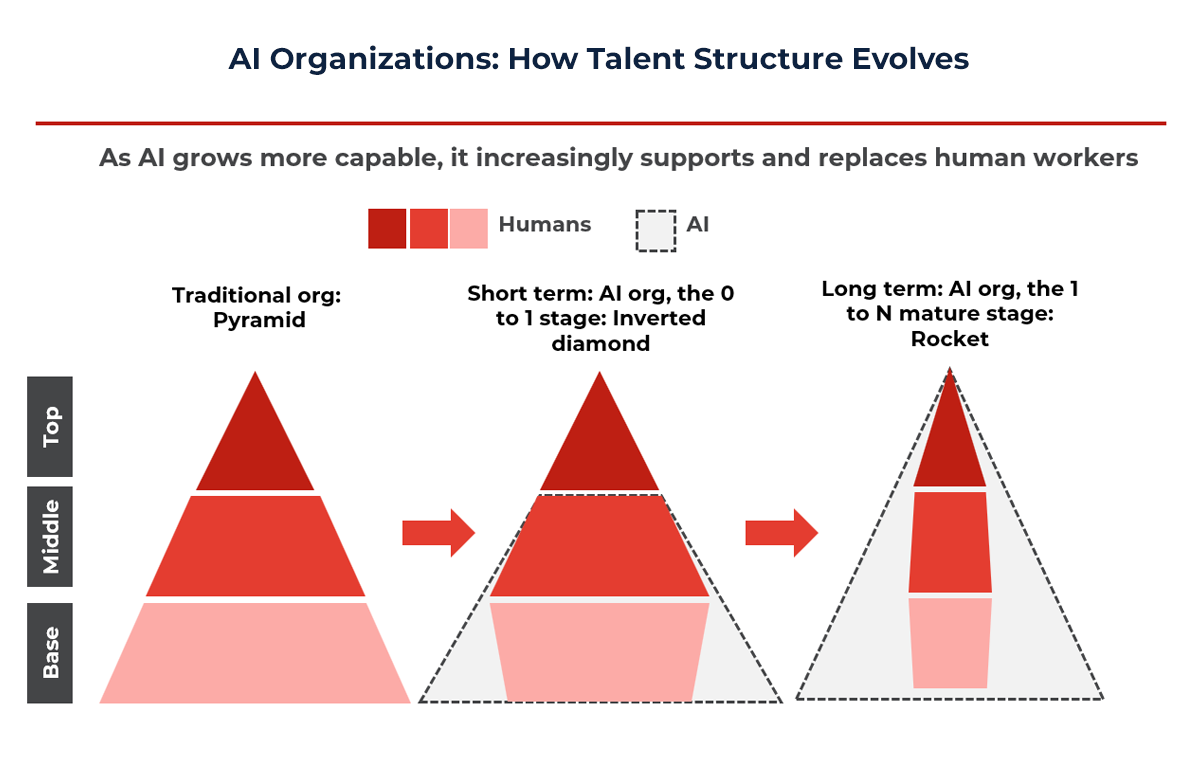
The traditional org chart is a pyramid: a wide base, clear layers, and heavy reliance on people to carry out the work. Once transformation begins, AI takes over the repetitive work at the base, and the middle and upper layers grow as a share of the whole. This is the inverted-diamond stage, where the strain of fitting business teams to AI shows most clearly. As AI reaches deeper, every layer thins out. Senior talent forms a dense core, while the middle and lower ranks focus on the complex problems AI cannot handle. The human workforce as a whole shrinks and concentrates toward the top, settling into a lean, well-coordinated rocket shape.
At the top, leaders of AI strategy and change. They set the direction for AI across strategy, technology, and the change effort, allocate AI resources wisely, and balance human and machine capability. They are not simply technical experts who understand algorithms; they also need strong skills in spotting AI risk and managing ethics.
In the middle, the bridge between people and machines. They understand both the business and the technology, and they are good at tying business processes to AI so its capabilities turn into real gains. This is the layer that closes the gap between technology and the business.
At the base, collaborators and value creators. Freed from repetitive execution, they focus on checking AI output, flagging complex problems, and turning new ideas into results. They spot issues on the front line and feed them back so AI improves, and they handle the situations AI still cannot.
The Real Contest Is Organizational
Organizational change driven by AI comes down to this: a leap in productive capability is forcing organizations to reshape how they create value. Where AI stalls today, the root cause is not a gap in technology but a systemic mismatch between an old bureaucratic structure and a new, intelligent kind of productivity. That mismatch shows up in the three traps of mindset, structure, and talent.
For companies, competing on AI is not a contest of technology alone. Only by breaking old management habits and transforming strategy, structure, collaboration, and talent together can a company hold a lasting edge through the AI wave. The competition ahead is not about how fast you can deploy technology. It is about who can keep turning AI into results within the bounds of regulation, governance, and accountability.
Author:
Nicolas Wang
Associate Partner
Author:
Mavis Li
Analyst
Share
Subscribe to New Articles and ARC Group Updates
Receive our latest market insights, news and reports, and business bulletins.
Introduction: The Assumption that No Longer Holds Jurisdiction is alpha. Not in theory, but in practice: across Asia, the corporates best positioned for the next cycle of capital raising are those that treated their cross-border structure as a strategic asset, not an administrative necessity. The assumption was simple: capital would naturally move toward the deepest […]
Executive Summary State Council Decree No. 837 (effective July 1, 2026) establishes a security-focused legal framework that reshapes outbound M&A. It does not ban consumer sector deals, but it changes how they must be structured, approved, and integrated. Expansion of Regulatory Scope: Individual Investors and Indirect Structures Brought into the Compliance Scope Resident individuals are, […]
Most companies approach an IPO as a milestone. In reality, it is a reset. The valuation is set, the story is told, and the stock begins trading. From that point onward, the market is no longer pricing potential. It is pricing delivery. The most critical period is often the six to eighteen months that follow, […]
Subscribe to New Articles and ARC Group Updates
Receive our latest market insights, news and reports, and business bulletins.
Manage Consent
To provide the best experiences, we use technologies like cookies to store and/or access device information. Consenting to these technologies will allow us to process data such as browsing behavior or unique IDs on this site. Not consenting or withdrawing consent, may adversely affect certain features and functions.
Functional
Always active
The technical storage or access is strictly necessary for the legitimate purpose of enabling the use of a specific service explicitly requested by the subscriber or user, or for the sole purpose of carrying out the transmission of a communication over an electronic communications network.
Preferences
The technical storage or access is necessary for the legitimate purpose of storing preferences that are not requested by the subscriber or user.
Statistics
The technical storage or access that is used exclusively for statistical purposes.The technical storage or access that is used exclusively for anonymous statistical purposes. Without a subpoena, voluntary compliance on the part of your Internet Service Provider, or additional records from a third party, information stored or retrieved for this purpose alone cannot usually be used to identify you.
Marketing
The technical storage or access is required to create user profiles to send advertising, or to track the user on a website or across several websites for similar marketing purposes.