What Separates Successful SPAC Transactions from the Rest
Share
Introduction
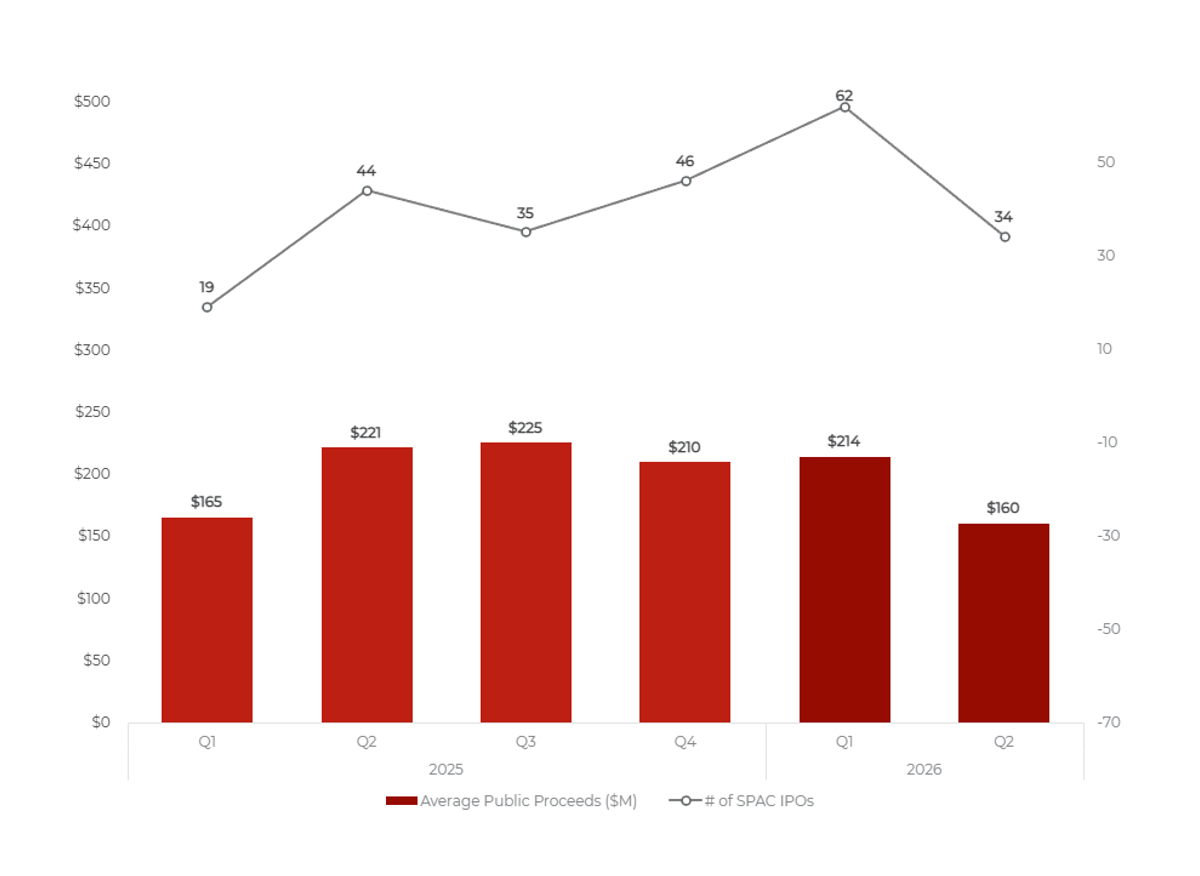
The SPAC market is reaccelerating, and the data is clear. Q1 2026 recorded 62(1) SPAC IPOs priced, followed by another 34(1), (2) transactions so far in Q2, representing approximately 67% of total activity seen during full-year 2025. On the de-SPAC side, 15 transactions have closed year-to-date for a combined pro-forma equity value of roughly $20B(3). When structured correctly, SPACs remain an effective and efficient path to the US capital markets.
What the aggregate numbers do not show is the increasing divergence in outcomes. In terms of total public proceeds raised at IPO, including partial or full exercise of the overallotment option, Q1 2026 averaged $214M(1), (2), declining to $160M(1), (2) in Q2. Trust sizes are compressing, and sponsors are adjusting accordingly, opting for leaner structures to improve execution certainty in a more selective investor environment. In this market, the difference between a transaction that closes and one that doesn’t, comes down to a handful of decisions made early in the process.
I. Structure Follows the Market, Not the Sponsor
Market knowledge is the foundation of a successful SPAC, and the sponsors with the strongest track records understand this better than anyone. Getting the structure right from the outset is not an optimization, but a prerequisite.
The average SPAC size in Q1 2026 was $190M(3), declining to $148M(3) in Q2, while average tenor compressed from 22 months(3) to 18 months over the same period. To compensate investors for smaller trust sizes, sponsors have been enhancing unit structures, shifting warrant coverage from one-quarter or one-half warrant toward one-half to one full warrant, and pairing these with fractional rights, typically one-quarter or one-fifth, with some outliers as low as one-tenth. These adjustments reflect a market in which investors have become more deliberate about where they allocate, and more demanding about the terms on which they do so.
The core tension sponsors navigate is a familiar one: limiting dilution going into the de-SPAC means keeping the unit structure lean, but a structure that falls short of market expectations means the IPO does not get done. The resolution is straightforward in principle, structure the deal against current market conditions rather than sponsor cost preferences, but consistently difficult in practice. SPACs that fail to align with market expectations often require S-1 amendments and refilings, adding weeks to the timeline and increasing transaction costs in the process.
GalaxyEdge Acquisition Corp (4) (NYSE: GLED.U) illustrates the point directly. The company originally filed its S-1 in October 2025 for a $60M IPO with a 1/7 right structure. Unable to meet market conditions, GalaxyEdge withdrew its registration and refiled on revised terms, upsizing to $100M and improving the unit structure to a 1/4 right. It priced successfully in March 2026, closed oversubscribed, with underwriters exercising the full overallotment option. The revised structure was not fundamentally different in kind; it was simply calibrated to where the market actually was.
II. Capital Discipline Is Part of the Structure
Beyond unit structure and trust size, disciplined capital planning plays a direct role in transaction execution, and is an area where sponsors consistently underestimate their requirements.
The SPAC IPO is lean on costs relative to a traditional IPO, but the underwriting discount remains the dominant line item and scales directly with trust size. Equally important is the budget for proceeds held outside of trust. These fund the vehicle’s working capital and keep it operational throughout its lifecycle. Underestimating this requirement is one of the more common and avoidable execution mistakes sponsors make, and one that forward planning addresses directly.
For sponsors whose unit structure or trust size falls short of market expectations, trust overfunding offers a practical compensating mechanism. By placing slightly more capital into trust than the headline offering size, the sponsor enhances the T-bill yield on investors’ parked capital, providing a meaningful additional incentive without restructuring the core terms of the deal. It is not a substitute for a well-calibrated core structure, but used deliberately in a competitive environment, it is an effective tool for closing the gap between sponsor positioning and investor expectations.
III. The Right Team Is a Structural Decision
A SPAC transaction requires a coordinated set of specialists: legal counsel to draft the offering documents and manage regulatory compliance; auditors to provide the financial clearance the market demands; a trustee to safeguard the proceeds; and an underwriter to place the deal. Each plays a defined role, and the quality of each matters.
What determines execution quality, however, is not any single specialist in isolation. It is the coordination across all of them. This is where the financial advisor’s role is most consequential. The financial advisor quarterbacks the transaction: setting the pace, managing the critical path, and ensuring all parties are working within the same framework at the same time. Equally important, an experienced financial advisor brings the investor network and market relationships that directly influence the quality and efficiency of demand generation.
Sponsors who engage experienced financial advisors from the outset start with an advantage that compounds through execution. The path from mandate to IPO pricing is shorter, the process is tighter, and the risk of mid-process corrections, which are both costly and confidence-eroding, is materially reduced. Those who engage too late typically find that catching up is significantly more expensive than starting right.
ARC Group as Trusted Financial Advisor
A successful SPAC transaction rests on a few core pillars: an accurate read of market conditions, the right trust size and unit structure, sufficient and well-planned capital, and experienced partners who have navigated the process before.
Experience in this market compounds. An advisor who has been through multiple SPAC cycles brings the judgment to structure deals with market-coherent terms, the relationships to drive investor demand, and the transactional discipline to protect sponsor economics throughout. That combination (market knowledge, investor access, and execution focus) is what determines whether the path from mandate to pricing is efficient or not.
ARC Group has been active in the SPAC market for over a decade, advising clients across jurisdictions on SPAC structuring and execution. From IPO strategy through to de-SPAC completion, we work alongside sponsors to build transactions that are well-structured and built to close.
Introduction: The Assumption that No Longer Holds Jurisdiction is alpha. Not in theory, but in practice: across Asia, the corporates best positioned for the next cycle of capital raising are those that treated their cross-border structure as a strategic asset, not an administrative necessity. The assumption was simple: capital would naturally move toward the deepest […]
Executive Summary State Council Decree No. 837 (effective July 1, 2026) establishes a security-focused legal framework that reshapes outbound M&A. It does not ban consumer sector deals, but it changes how they must be structured, approved, and integrated. Expansion of Regulatory Scope: Individual Investors and Indirect Structures Brought into the Compliance Scope Resident individuals are, […]
Overview Corporate AI has settled into a familiar pattern: broad use, thin value. Close to 90% of companies now use AI routinely in at least one business function, yet only a handful have turned that into value at enterprise scale. The bottleneck is not the technology. It is the organization. At its core, AI transformation […]
Subscribe to New Articles and ARC Group Updates
Receive our latest market insights, news and reports, and business bulletins.
Manage Consent
To provide the best experiences, we use technologies like cookies to store and/or access device information. Consenting to these technologies will allow us to process data such as browsing behavior or unique IDs on this site. Not consenting or withdrawing consent, may adversely affect certain features and functions.
Functional
Always active
The technical storage or access is strictly necessary for the legitimate purpose of enabling the use of a specific service explicitly requested by the subscriber or user, or for the sole purpose of carrying out the transmission of a communication over an electronic communications network.
Preferences
The technical storage or access is necessary for the legitimate purpose of storing preferences that are not requested by the subscriber or user.
Statistics
The technical storage or access that is used exclusively for statistical purposes.The technical storage or access that is used exclusively for anonymous statistical purposes. Without a subpoena, voluntary compliance on the part of your Internet Service Provider, or additional records from a third party, information stored or retrieved for this purpose alone cannot usually be used to identify you.
Marketing
The technical storage or access is required to create user profiles to send advertising, or to track the user on a website or across several websites for similar marketing purposes.