How SPACs Are Being Used as Execution Solutions Rather Than Shortcuts
Share
Executive Summary
A special purpose acquisition company (SPAC) is a publicly listed shell that raises capital and subsequently merges with an operating company through a De-SPAC transaction to take it public. In practice, the De-SPAC represents the effective listing event for the target: this is when the operating business becomes a public reporting company and key deal terms — valuation, governance, capitalization, and disclosure obligations — are finalised for public investors. The SPAC structure is increasingly being used not as a shortcut around traditional listing requirements, but as a coordinated execution framework that combines a listing outcome, capital raise, and M&A negotiation into a single transaction.
1. From Alternative Listing Path to Execution Framework
SPACs are increasingly positioned as a transaction execution framework rather than a faster IPO. The framework enables broader corporate objectives: capital formation, strategic structuring, M&A integration, investor syndication, governance reset, and cross-border positioning. When applied with IPO-level governance, disclosure, and diligence standards, the De-SPAC process aligns with the same regulatory expectations applied to traditional listings. SEC rules codify this directly, requiring clear disclosure of the rationale for the De-SPAC and, where practicable, quantified benefits or detriments.
2. How the Structure Works
A SPAC IPO places proceeds into a trust account, preserving capital until a business combination is completed. This allows transaction planning to be built around available cash at closing rather than relying on an IPO order book at a single point in time. De-SPAC transactions commonly incorporate additional private capital, most often PIPE financing, to fund larger transactions and establish a committed institutional investor base alongside the public listing. Regulators have explicitly described the De-SPAC as a business combination that results in the target becoming part of a U.S. reporting company. The public framework requires extensive upfront disclosure around the transaction’s background, terms, and effects, creating a more standardised public readiness process that supports execution certainty.
3. Four Strategic Advantages
Structural Flexibility. A De-SPAC can be designed with a longer, more flexible public marketing period for price discovery, and can incorporate earnouts to align valuation outcomes with future performance milestones. These features are difficult to replicate within a traditional IPO format.
Capital Certainty. De-SPAC transactions can be structured to provide capital certainty through PIPE commitments, allowing management to align the listing with a funded operating plan rather than depending on a single window for IPO demand. Where the transaction is structured around a strategic investor or sector-specific capital source, the PIPE can also serve as a signal of institutional conviction in the combined entity.
Sponsor-Led Execution. Because a SPAC has no operating history, early disclosure and transaction planning centre on sponsor experience: the sponsor’s role in sourcing the target, negotiating the combination, and assembling complementary financing. When the sponsor group is sector-focused and transaction-experienced, this aligns naturally with an execution partner model.
Negotiated Terms and Lifecycle Tailoring. A SPAC merger allows bespoke terms that connect valuation, cash delivery, and dilution to post-closing performance through earnouts, and permits conditions such as minimum cash requirements and backstops to be hardcoded as closing requirements.These are structural features that standard IPO formats cannot accommodate.
4. Market Evidence: Five Recently Announced De-SPAC Transactions
Market data as of 29 May 2026
ProLogium Technology & Translational Development Acquisition Corp. (Nasdaq: TDAC). China Taiwan-based renewable energy company ProLogium Technology announced a business combination with Translational Development Acquisition Corp. at a target equity value of approximately $3.8 billion, one of the larger recently announced De-SPACs.
Newcleo Ltd. & NewHold Investment Corp III (Nasdaq: NHICU). France-headquartered Newcleo Ltd. announced a De-SPAC with NewHold Investment Corp III at a target equity value of approximately $2.4 billion, with a $220 million PIPE alongside, demonstrating how the structure combines a public listing path with additional committed capital.
CPRO Holding Limited & Lakeshore Acquisition III Corp. (Nasdaq: LCCCU). South Korea-based technology company CPRO Holding Limited announced a business combination at a target equity value of approximately $185 million, illustrating that De-SPACs are equally applicable to smaller growth companies seeking U.S. public market access.
Terra Quantum & Axiom Intelligence Acquisition Corp 1 (Nasdaq: AXINU). Switzerland-headquartered Terra Quantum announced a business combination at a target equity value of approximately $3.5 billion, reflecting how specialised technology companies are using De-SPACs to scale visibility, capital access, and public market positioning.
Eight Directions Global Limited & Quartzsea Acquisition Corporation (Nasdaq: QSEAU). U.S.-headquartered manufacturing company Eight Directions Global Limited announced a De-SPAC at a target equity value of approximately $515 million, demonstrating that the route serves operating companies in traditional sectors, not only high-profile technology or energy names.
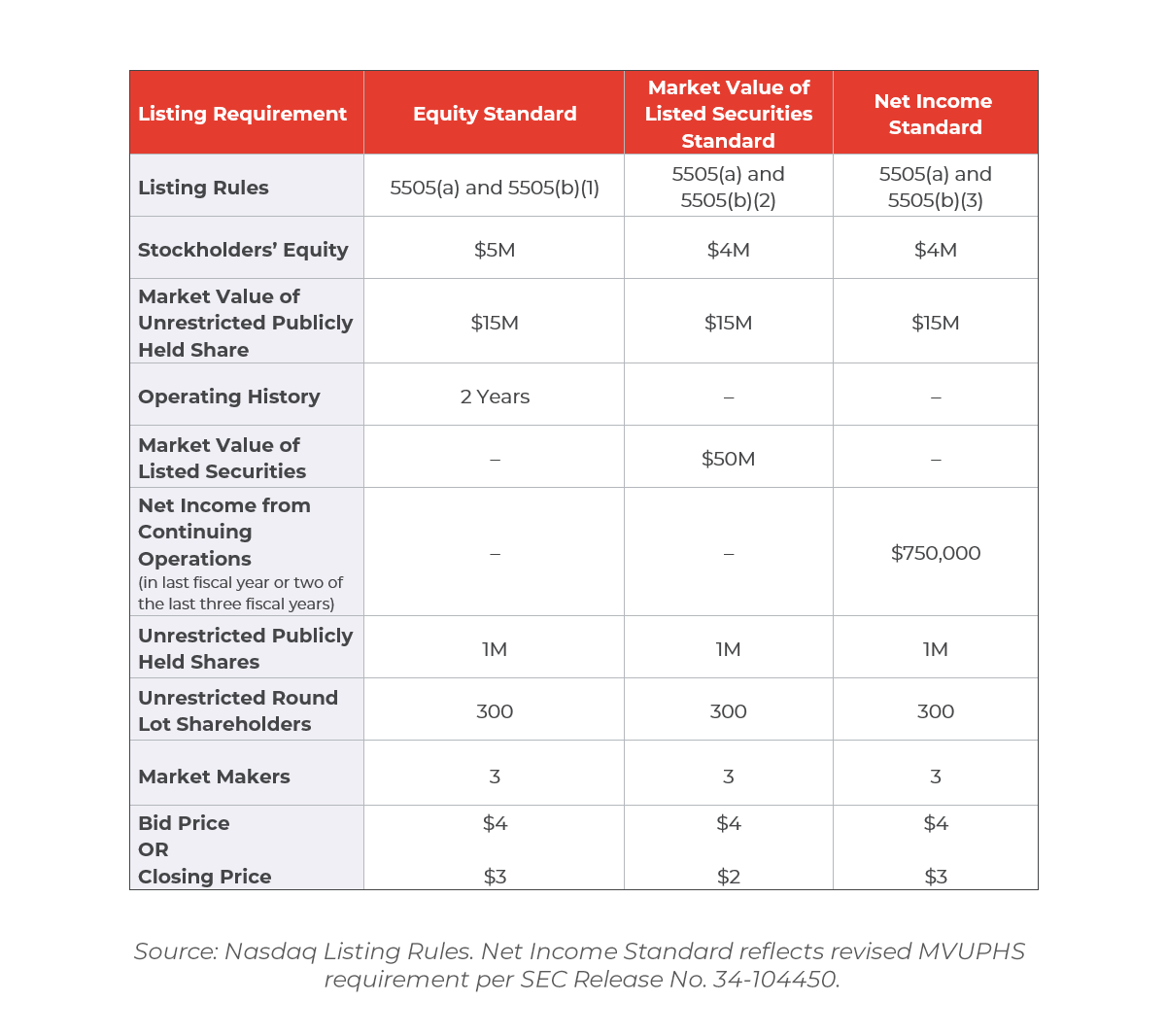
5. Nasdaq Capital Market Listing Requirements
The table below sets out the financial and liquidity thresholds applicable to initial listings on the Nasdaq Capital Market. Understanding which standard applies is a prerequisite to structuring the public readiness plan around a De-SPAC transaction.
6. Why Traditional IPO Constraints Make SPACs Relevant
A key reason SPACs function as execution solutions for mid-market issuers is that traditional IPO listing requirements can shift in ways that disproportionately affect companies where public float and capital-raise sizing require careful management. In a rule change approved on an accelerated basis, Nasdaq revised its listing rules to increase the minimum Market Value of Unrestricted Publicly Held Shares (MVUPHS) for certain initial listings. The revision to Listing Rules 5505(b)(3)(C) and 5405(b)(1)(C) requires companies applying the Net Income Standard to maintain a MVUPHS of at least $15 million. Nasdaq’s stated rationale is liquidity and price discovery: ensuring newly listed companies have a sufficient initial pool of tradeable shares to support orderly trading from day one. For mid-market companies, this raises the importance of planning around float size, distribution, and initial liquidity well before the listing date.
7. How SPAC Structures Address These Constraints
SPAC and De-SPAC structures address the liquidity and float challenges in two ways. First, they combine a pre-existing listed platform with transaction-linked capital assembly, using PIPE financing to fund larger transactions and support the capital plan at closing. Second, the business combination process — including shareholder materials and where applicable an S-4 or F-4 registration — creates a structured path into the public reporting regime with a defined transaction timetable, rather than the compressed and market-dependent timeline of a traditional IPO.
ARC Group Advisory Perspective
ARC Group has been recognised by SPACInsider as a global leader in De-SPAC transactions, ranking first by both transaction volume and value in 2022. ARC Group Securities LLC has served as bookrunner and financial advisor on transactions spanning 17 countries across Asia, North America, Europe, Latin America, and Africa. This integrated advisory and broker-dealer platform enables coordination across sponsors, targets, and capital providers in complex and cross-border transactions. ARC Group advises clients across each stage of the De-SPAC process, from early transaction structuring and target identification through to closing and post-listing support.
Conclusion
SPACs deliver a coordinated, structurally flexible route to a public listing, with greater certainty around capital, timing, and investor composition than a traditional IPO can provide at a single market window. For issuers operating across multiple jurisdictions, the quality of the advisor structuring and executing that route is the variable that matters most.
Introduction: The Assumption that No Longer Holds Jurisdiction is alpha. Not in theory, but in practice: across Asia, the corporates best positioned for the next cycle of capital raising are those that treated their cross-border structure as a strategic asset, not an administrative necessity. The assumption was simple: capital would naturally move toward the deepest […]
Executive Summary State Council Decree No. 837 (effective July 1, 2026) establishes a security-focused legal framework that reshapes outbound M&A. It does not ban consumer sector deals, but it changes how they must be structured, approved, and integrated. Expansion of Regulatory Scope: Individual Investors and Indirect Structures Brought into the Compliance Scope Resident individuals are, […]
Overview Corporate AI has settled into a familiar pattern: broad use, thin value. Close to 90% of companies now use AI routinely in at least one business function, yet only a handful have turned that into value at enterprise scale. The bottleneck is not the technology. It is the organization. At its core, AI transformation […]
Subscribe to New Articles and ARC Group Updates
Receive our latest market insights, news and reports, and business bulletins.
Manage Consent
To provide the best experiences, we use technologies like cookies to store and/or access device information. Consenting to these technologies will allow us to process data such as browsing behavior or unique IDs on this site. Not consenting or withdrawing consent, may adversely affect certain features and functions.
Functional
Always active
The technical storage or access is strictly necessary for the legitimate purpose of enabling the use of a specific service explicitly requested by the subscriber or user, or for the sole purpose of carrying out the transmission of a communication over an electronic communications network.
Preferences
The technical storage or access is necessary for the legitimate purpose of storing preferences that are not requested by the subscriber or user.
Statistics
The technical storage or access that is used exclusively for statistical purposes.The technical storage or access that is used exclusively for anonymous statistical purposes. Without a subpoena, voluntary compliance on the part of your Internet Service Provider, or additional records from a third party, information stored or retrieved for this purpose alone cannot usually be used to identify you.
Marketing
The technical storage or access is required to create user profiles to send advertising, or to track the user on a website or across several websites for similar marketing purposes.