How Regulatory Pressure Is Changing Capital Raising After Listing (Private Placement / ELOC secondary angle)
Share
Introduction
For companies that reach the public market before achieving profitability, the listing is not the finish line. It is the start of a more demanding financing challenge. Without a dependable route to capital after listing, many small-caps struggle to stay funded long enough to deliver on the thesis that brought them public.
The challenge has grown more acute. Options available to larger issuers, such as firm commitment underwriting and sizable follow-on offerings, are largely closed to smaller firms. The tightening regulatory framework constrains the post-public landscape, making the remaining alternatives slower, costlier, and more dilutive, with the equity line of credit (ELOC) becoming the increasingly favored option. However, the guardrails are not entirely one-sided. The same rules that raise the cost of capital also protect existing shareholders from excessive dilution.
Key Regulatory Constraints
With a variety of post-public financing options, the one most affected by recent SEC regulation is the equity line of credit (ELOC): an arrangement in which an investor agrees to purchase newly issued shares from a company over time, up to a set dollar cap, at the company’s discretion. Similar to an ATM, companies can exercise the option when they require cash, exchanging the capital for stock, with the security priced at a discount to the market. (Its close cousin, the PIPE: a private placement of shares or convertibles to select investors, raises many of the same questions and recurs below.) The bottleneck stems from SEC classification. On paper, an equity line looks like a secondary, an investor reselling shares, but the SEC often treats it as an indirect primary, the company itself selling new stock to the public. The classification carries real consequences. A primary shelf runs on Form S-3, available only to issuers that have been reporting companies for at least twelve months, have kept their SEC filings current and timely, and have not recently defaulted on debt or preferred-dividend obligations. Public float sets capacity rather than eligibility: at $75 million or more, an eligible issuer can run an unlimited primary shelf, while below that line the “baby shelf” rule caps sales at one-third of public float on a rolling 12-month basis, a limit generally insufficient for issuers with urgent or recurring cash needs. Most are directed to an S-1 resale instead, which faces close staff scrutiny.1
The shift is best seen in a recent example. In a May 2025 comment letter on the company’s equity-line S-1, SEC staff pressed the central question in many ELOC registrations: should the equity-line investor be named an underwriter, and, if not, why the transaction qualifies as a genuine secondary rather than an indirect primary; staff pointed the company to the SEC’s factor tests for distinction.² The questions are not new. A decade earlier, the staff reached that conclusion outright in its review of Recro Pharma’s $2.5 million equity line with Aspire Capital, deeming the registration a primary offering given its size relative to float, leaving the company with two paths: register the resale after each draw, or shrink the line and refile.³ Both examples highlight the framework that small-caps must now work within.
However, not all regulatory movements cut one way. The SEC’s May 2026 proposals would ease the reporting burden, allowing issuers to swap quarterly Form 10-Q filings for a semiannual Form 10-S, alongside an election-based disclosure cadence⁴, but they leave the core capital-raising constraints on small-caps largely intact.
Layered on top are the exchange shareholder-approval rules, targeting two different points. NYSE’s Section 312.03(b) spotlights who is buying: sell even a 1-5% stake to an insider and a vote is required, under concerns of self-dealing. The “20% Rule” focuses on dilution: how much and how cheap the shares become after issuance. A vote is triggered only when a company issues 20% or more of its outstanding shares and prices them below market. Both conditions must be met: a large issuance at a fair price and a cheap sale of a small block both pass this clause. In short, 312.03(b) addresses whether insiders are being advantaged, while the 20% Rule guards against flooding the market with cheaply priced shares. The regulations maintain the same threshold that catches the Series C/D/E PIPEs small-caps stack alongside their equity lines.5
Stacked together, the rules do not prevent small-caps from raising capital so much as funnel them toward a shrinking set of instruments, adjusting the playbook these firms follow to approach the market.
Market Response and Instrument Selection
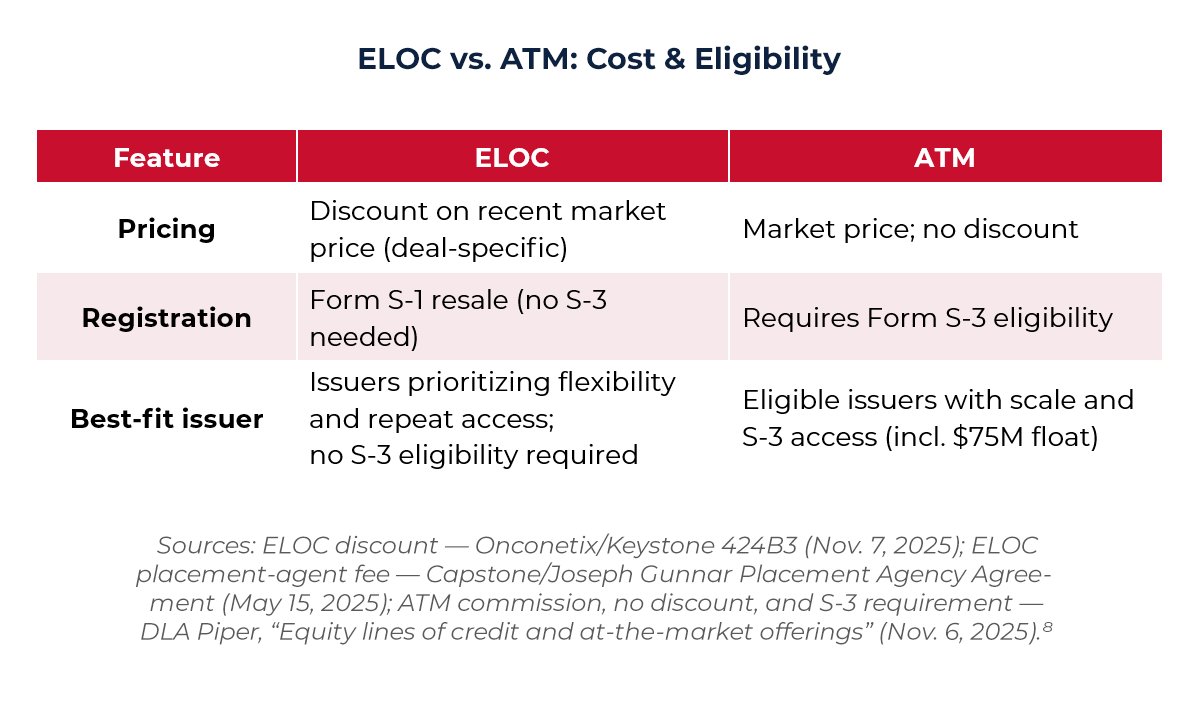
In light of the regulatory constraints, issuers have not stopped raising capital, but rather have adjusted how they access it. The post-listing financing toolkit is broad on paper: traditional follow-ons, at-the-market (ATM) programs, registered direct offerings, convertible notes, PIPEs, and equity lines of credit. In reality, each option carries eligibility, cost, or execution constraints. A follow-on offering demands underwriter appetite that small-caps rarely command, while an ATM requires Form S-3 eligibility, including the same $75 million public float threshold many micro-cap issuers cannot clear. What the market has increasingly leaned on is the equity line: a flexible facility for companies that need recurring access to capital but may not be positioned for a conventional underwritten offering.
Onconetix, Inc. (Nasdaq: ONCO) is a representative case. In October 2024, the company established an equity line of up to $25 million with Keystone Capital Partners⁶, under which Keystone committed to purchasing newly issued Onconetix shares, at a roughly 10% discount to market, with the ability to resell into the open market; the resale shares were registered in November 2025. The arrangement met a clear need: Onconetix is a commercial-stage biotech with a going-concern warning and roughly $0.3 million in cash as of mid-2025, making flexible capital access important to continued operations, with more conventional options unavailable. Notably, Onconetix also directly addressed the SEC classification issue, stating that the equity-line investor “is an underwriter within the meaning of Section 2(a)(11),” rather than framing the arrangement as a conventional secondary resale.
The transaction also highlights how exchange rules shape execution. The 4.99% beneficial ownership cap limited Keystone’s ability to accumulate shares above a specified threshold, while the 19.99% Exchange Cap restricted issuances without the proper shareholder approval. When Onconetix sought to issue shares beyond that cap, it subsequently obtained the necessary shareholder approval, staying within the bounds of the regulation. The rules do not necessarily block financing, but rather influence how facilities are sized, sequenced, and approved.⁷
The trade-off is dilution. Against approximately 1.5 million shares outstanding, the line registered 5.1 million shares, and at a $1 share price, the issuance would rise to roughly 92% of the company. For issuers with limited cash and ongoing capital needs, this is the trade-off of flexible access: equity lines can provide access to capital, but often at a significant cost to existing shareholders. Onconetix also layered Series C, D, and E preferred placements alongside the equity line, underscoring that small-cap financing is often built through multiple instruments, and is rarely a single, single financing arrangement. These transactions are often supported by best-efforts placement agents, who earn fees without committing firm capital, a model suited to smaller, more complex financings where traditional firm-commitment underwriting may be less available.
Implications for Issuers and Placement Agents
For issuers, adjusted regulations have made post-public financing more planning-intensive and structure-dependent, but the financing routes remain open. ELOCs and PIPEs remain viable tools for small-cap issuers, though that flexibility carries trade-offs in pricing, fees, regulatory review, and dilution. Dilution is the strongest of these, but whether it proves manageable or destructive depends on factors like sizing, timing, instrument selection, and market communication.
Regulatory and exchange requirements are now embedded in financing strategy from the outset. The 19.99% Exchange Cap, 20% Rule vote, S-1 resale process, and SEC staff comments are not one-time considerations; they shape how issuers size facilities, sequence drawdowns, and communicate dilution to the market.
For placement agents, the model has shifted to best-efforts execution, rather than balance-sheet commitment. Agents can earn fees for sourcing and executing transactions without underwriting the securities themselves, reducing capital risk while creating a steady pipeline of smaller mandates. The economics can also be attractive: ELOC cash fees on proceeds typically run several points above ATM commissions, though both vary by deal size and structure. As financing structures become more specialized, the placement agent’s role has expanded beyond distribution to include structuring, investor targeting, approval planning, and execution coordination.
Regulatory pressure has not shut off small-cap capital formation; it has repriced and reshaped it. The May 2026 reforms may ease parts of the reporting burden, but the financing challenge remains one of structure, timing, and execution. For issuers and placement agents alike, the premium now lies in navigating the constraints effectively: sequencing drawdowns beneath exchange caps, timing registrations around staff review, securing shareholder approval when needed, and pricing dilution in a way the market can absorb. In this environment, access to capital remains available, but disciplined execution increasingly determines whether that capital is constructive.
ARC GROUP ADVISORY PERSPECTIVE
ARC Group is an international investment banking and advisory firm with offices across Asia, North America, Europe, Latin America, and Africa. Through its FINRA-registered broker-dealer, ARC Group Securities LLC, the firm advises small-cap and mid-market issuers on post-listing capital structure, ELOC and PIPE execution, and placement agent mandates in U.S. public markets. ARC Group has advised on transactions spanning 17 countries and brings an integrated advisory and broker-dealer platform to bear on financing mandates that require both structural expertise and cross-border execution. For issuers navigating the post-listing financing landscape, we welcome the opportunity to discuss a specific mandate.
Introduction: The Assumption that No Longer Holds Jurisdiction is alpha. Not in theory, but in practice: across Asia, the corporates best positioned for the next cycle of capital raising are those that treated their cross-border structure as a strategic asset, not an administrative necessity. The assumption was simple: capital would naturally move toward the deepest […]
Executive Summary State Council Decree No. 837 (effective July 1, 2026) establishes a security-focused legal framework that reshapes outbound M&A. It does not ban consumer sector deals, but it changes how they must be structured, approved, and integrated. Expansion of Regulatory Scope: Individual Investors and Indirect Structures Brought into the Compliance Scope Resident individuals are, […]
Overview Corporate AI has settled into a familiar pattern: broad use, thin value. Close to 90% of companies now use AI routinely in at least one business function, yet only a handful have turned that into value at enterprise scale. The bottleneck is not the technology. It is the organization. At its core, AI transformation […]
Subscribe to New Articles and ARC Group Updates
Receive our latest market insights, news and reports, and business bulletins.
Manage Consent
To provide the best experiences, we use technologies like cookies to store and/or access device information. Consenting to these technologies will allow us to process data such as browsing behavior or unique IDs on this site. Not consenting or withdrawing consent, may adversely affect certain features and functions.
Functional
Always active
The technical storage or access is strictly necessary for the legitimate purpose of enabling the use of a specific service explicitly requested by the subscriber or user, or for the sole purpose of carrying out the transmission of a communication over an electronic communications network.
Preferences
The technical storage or access is necessary for the legitimate purpose of storing preferences that are not requested by the subscriber or user.
Statistics
The technical storage or access that is used exclusively for statistical purposes.The technical storage or access that is used exclusively for anonymous statistical purposes. Without a subpoena, voluntary compliance on the part of your Internet Service Provider, or additional records from a third party, information stored or retrieved for this purpose alone cannot usually be used to identify you.
Marketing
The technical storage or access is required to create user profiles to send advertising, or to track the user on a website or across several websites for similar marketing purposes.