Our offices across 12 countries and 3 continents all share the same vision. Your achievement is the reason for our existence and your growth is our passion.
Indonesia’s New Capital Reveals New Business Opportunities
Share
On January 18th, 2022, the Indonesian House of Representatives officially approved a law to move the capital of this island nation to East Kalimantan province on the island of Borneo. The new capital was named Nusantara, which means “archipelago” in Javanese. After several delays due to the COVID-19 pandemic, the capital construction project was officially started on March 14th, 2022.
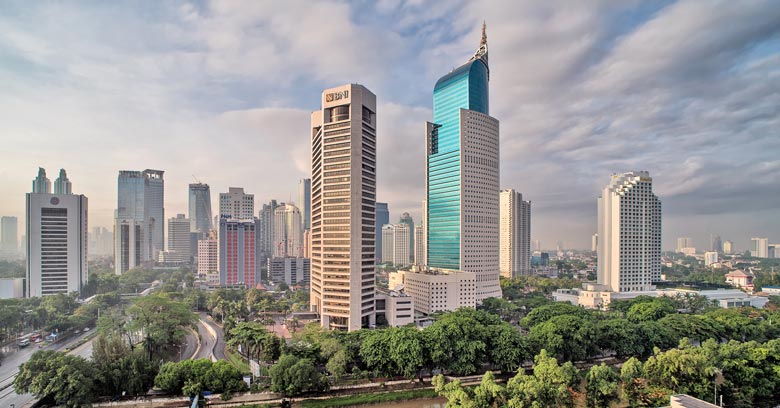
The current capital – Jakarta is overpopulated with 10.5 million people, making traffic jams a serious problem; the city is also flood-prone and the fastest-sinking city in the world due to the over-exploitation of groundwater due to infrastructural issues from when the city was built in the 1600s. East Kalimantan, on the other hand, is located on the Indonesian island of Borneo and, according to scientific studies, is one of the safest places in this island nation because it is less affected by earthquakes, volcanoes, and tsunamis, which this Pacific Ring of Fire is otherwise regularly subjected to. Relocating the capital to the new region is therefore an attempt to address the major environmental challenges that Jakarta faces, and to promote prosperity in surrounding areas as well.
Data from Indonesia’s National Planning and Development Agency announced that the total land area for the new capital will be about 256,143 hectares (about 2,561 square kilometres), nearly four times larger than Jakarta which only covers an area of 661.5 square kilometres. The site is set among pristine rainforests, and city planners want the new capital to be built as an eco-tourism site in Indonesia. The move is projected to cost 466 trillion Rp (32.5 billion USD), where the government will be covering 19% of the cost and the rest is expected to be funded by public-private partnerships and direct investment by both state-owned firms and the private sector.
The Ambitious Plan
The Nusantara Capital Construction Project will be implemented in different phases. The process will begin with the construction of the central government area, which will house the presidential palace, government office buildings, and residences for government employees, including the military and police. About 60,000 government employees are expected to be relocated from Jakarta to Nusantara by the end of 2023. Estimates also suggest that the population in the new Indonesian capital will reach around 320,000 by 2045. Construction of the new capital is estimated to complete within 15 to 20 years.
Many expectations are set for the new capital of Indonesia. First, the relocation will ease the environmental and traffic burden that Jakarta currently experiences. Second, the new capital will also positively impact 10 districts and cities in the region, most of which still have a weak infrastructure.
In the long run, President Joko Widodo desires to build Nusantara into a “ten-minute city”, a city with a full public transport system with which people can move from one point to another within 10 minutes. The rate of public transport commuting in the new capital will be increased to 80% compared to the current levels in Jakarta. In addition, Nusantara is planned to have 70% of the area filled with trees. The new capital is expected to help realize the country’s commitment to tackling climate change and reaching the goal of using 100% renewable energy by 2060. In a speech at the State Palace, President Joko Widodo hoped that the new capital would be a preeminent representative of the nation, and set an example for the development of other cities.
Potentials for Investment and Business
With the ambitions set for Nusantara, the new capital is revealing its broad-ranging potential for medium and long-term investment in many for many businesses and industries. As constructing the new capital will require building new roads, railways, houses, and offices, as well as require a complex infrastructure to enable the “ten-minute-city” and green hub, the city, in particular transportation, will need intensive investments and innovative solutions.
Along with the improved infrastructure and increased attention on the new capital, the tourism of East Kalimantan also shows a promising potential, which in turn will boost the economy of the whole area. The region has a rich biodiversity, with over 11 primate species, over 130 mammals, 3000 types of trees, nature reserves, and rainforests. The unique ecosystem will attract tourists and allow the tourism industries to flourish.
While fossil fuel-fired power plants currently generate the majority of electricity in East Kalimantan, the president wants the future capital to be mainly powered by renewable energy. This presents a substantial potential for overseas investors within the sustainability sector, for example in solar energy and biomass. There’s also the prospect of constructing a large-scale electricity storage system to channel power from the neighbouring province of North Kalimantan, where the government is currently constructing a hydroelectric project.
Jakarta will remain the commercial and financial centre of Indonesia, however, the capital relocation plan aims to expand economic activity beyond the island of Java, as well as ensure more equitable economic development, especially in eastern Indonesia. East Kalimantan is known for its wealth of resources, which include coal, gold, and oil. Opening new trade routes via eastern Indonesia might help the province tap into new export markets, particularly for mining commodities like coal and gold, which already account for 80% of Indonesia’s exports.
To attain the ambitious goals set for the new capital, investments will be required in a large variety of sectors. The opportunities are not limited to the already mentioned sectors as the construction of a new city will naturally affect a wide range of industries, investors can find plenty of new opportunities in Nusantara and Eastern Kalimantan.
Summary
In short, with the relocation of the capital, hopes of a greener city and a more uniform development across the country, Nusantara discloses opportunities in Indonesia and across the Eastern region. Infrastructure, tourism, trade, and energy are the four dominant pillars that will initially receive the most attention, but foreign investors and businesses are encouraged to tap into this opportunity as high growth can be expected across a wide range of industries as well.
Executive Summary State Council Decree No. 837 (effective July 1, 2026) establishes a security-focused legal framework that reshapes outbound M&A. It does not ban consumer sector deals, but it changes how they must be structured, approved, and integrated. Expansion of Regulatory Scope: Individual Investors and Indirect Structures Brought into the Compliance Scope Resident individuals are, […]
Overview Corporate AI has settled into a familiar pattern: broad use, thin value. Close to 90% of companies now use AI routinely in at least one business function, yet only a handful have turned that into value at enterprise scale. The bottleneck is not the technology. It is the organization. At its core, AI transformation […]
Most companies approach an IPO as a milestone. In reality, it is a reset. The valuation is set, the story is told, and the stock begins trading. From that point onward, the market is no longer pricing potential. It is pricing delivery. The most critical period is often the six to eighteen months that follow, […]
Subscribe to New Articles and ARC Group Updates
Receive our latest market insights, news and reports, and business bulletins.
Manage Consent
To provide the best experiences, we use technologies like cookies to store and/or access device information. Consenting to these technologies will allow us to process data such as browsing behavior or unique IDs on this site. Not consenting or withdrawing consent, may adversely affect certain features and functions.
Functional
Always active
The technical storage or access is strictly necessary for the legitimate purpose of enabling the use of a specific service explicitly requested by the subscriber or user, or for the sole purpose of carrying out the transmission of a communication over an electronic communications network.
Preferences
The technical storage or access is necessary for the legitimate purpose of storing preferences that are not requested by the subscriber or user.
Statistics
The technical storage or access that is used exclusively for statistical purposes.The technical storage or access that is used exclusively for anonymous statistical purposes. Without a subpoena, voluntary compliance on the part of your Internet Service Provider, or additional records from a third party, information stored or retrieved for this purpose alone cannot usually be used to identify you.
Marketing
The technical storage or access is required to create user profiles to send advertising, or to track the user on a website or across several websites for similar marketing purposes.