Our offices across 12 countries and 3 continents all share the same vision. Your achievement is the reason for our existence and your growth is our passion.
India’s Textile Industry is Resilient, Backed by the Government for Further Growth
Share
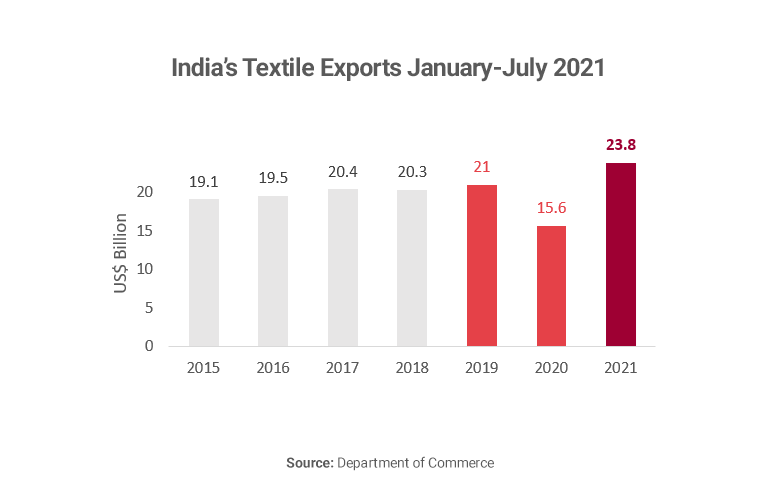
Textile exports in India for the first half of 2021 have surpassed pre-pandemic levels, a welcomed development after the dire effects that the COVID pandemic has inflicted on the economy. The Indian government recently introduced a scheme that is expected to help the industry further expand its growth within the next five years.
Resilience Amidst the Pandemic
From January to July 2021, India exported US$23.8 billion worth of textile products, 52.6% higher than the same period in 2020, and 13.7% higher than the pre-pandemic level of 2019. This positive result came amid a heavy summer as COVID cases surged in the country.
A leading factor in this exceptional growth is the China Plus One strategy, the business strategy to avoid investing in only China and diversifying into additional countries, which has been adopted by many European and US apparel brands. The US ban on Chinese cotton is also a contributing factor. Improved global demands, especially from the US and European markets, has helped the Indian textile industry stay afloat.
In terms of export destinations, a major share of the exported textile products during January-July 2021 went to the US, followed by Bangladesh and United Arab Emirates (UAE). Interestingly, a total of US$6.05 billion of textile products were exported to the US, three times as much as the US$2.07 billion export value to Bangladesh.
The textile industry contributed to 7% of the industrial output, 2% to the nation’s GDP, 12% of the export earnings, and accounted for 5% of the global market. India is one of the largest textile producers in the world, placed as the sixth largest textile exporter in the world.
Government Approves New Scheme to aid the Textile Industry
In September 2021, the Indian Union Cabinet approved a Production-Linked Incentive (PLI) scheme for the textile sector worth US$1.42 billion. The purpose of the scheme is to attract new private investments of US$2.56 billion for in-demand textile production, with an expected total turnover of US$40.42 billion over five years. The in-demand textile segments are Man-Made Fiber (MMF) fabrics, garments, and technical textiles.
The focus of the PLI scheme would help boost the value of the textile sector and shift production to align with global demands. Among the APAC countries, India is currently strong in exporting upstream segments of raw materials and yarn spinning, while much weaker in fabrics and finished goods. This evidently limits the value of India’s export. China, in comparison, has a higher share than India in all segments, including downstream products that generate higher value.
Moreover, the majority of India’s apparel export is cotton products, while the trend in global consumption is towards manmade textiles.
The PLI scheme will give incentives in two categories. With the first category, any person or company that invest a minimum of US$40.42 million in plants, machinery, equipment, and civil works (except for land and administrative building cost) to produce either MMF fabrics, garments, or technical textiles, will be eligible to participate. The second category requires investors to spend a minimum of US$13.47 million under the same conditions.
Companies participating in the scheme are expected to meet the minimum turnover requirements within 2 years. If they pass, they will be entitled to 3-11% of the incremental revenues year-on-year for five years. Any subsequent reception of the incentives will be heavily dependent on the companies’ performance in those years.
The rebound of the textile and garments industry in India is more than impressive as the country braves through the COVID pandemic. The government’s fresh policy arrived at the right time as the sector competes to regain its position globally. Fueled by the unprecedented growth and the government’s strong support, India’s textile industry is expected to magnify both in scales and specialities.
Executive Summary State Council Decree No. 837 (effective July 1, 2026) establishes a security-focused legal framework that reshapes outbound M&A. It does not ban consumer sector deals, but it changes how they must be structured, approved, and integrated. Expansion of Regulatory Scope: Individual Investors and Indirect Structures Brought into the Compliance Scope Resident individuals are, […]
Overview Corporate AI has settled into a familiar pattern: broad use, thin value. Close to 90% of companies now use AI routinely in at least one business function, yet only a handful have turned that into value at enterprise scale. The bottleneck is not the technology. It is the organization. At its core, AI transformation […]
Most companies approach an IPO as a milestone. In reality, it is a reset. The valuation is set, the story is told, and the stock begins trading. From that point onward, the market is no longer pricing potential. It is pricing delivery. The most critical period is often the six to eighteen months that follow, […]
Subscribe to New Articles and ARC Group Updates
Receive our latest market insights, news and reports, and business bulletins.
Manage Consent
To provide the best experiences, we use technologies like cookies to store and/or access device information. Consenting to these technologies will allow us to process data such as browsing behavior or unique IDs on this site. Not consenting or withdrawing consent, may adversely affect certain features and functions.
Functional
Always active
The technical storage or access is strictly necessary for the legitimate purpose of enabling the use of a specific service explicitly requested by the subscriber or user, or for the sole purpose of carrying out the transmission of a communication over an electronic communications network.
Preferences
The technical storage or access is necessary for the legitimate purpose of storing preferences that are not requested by the subscriber or user.
Statistics
The technical storage or access that is used exclusively for statistical purposes.The technical storage or access that is used exclusively for anonymous statistical purposes. Without a subpoena, voluntary compliance on the part of your Internet Service Provider, or additional records from a third party, information stored or retrieved for this purpose alone cannot usually be used to identify you.
Marketing
The technical storage or access is required to create user profiles to send advertising, or to track the user on a website or across several websites for similar marketing purposes.